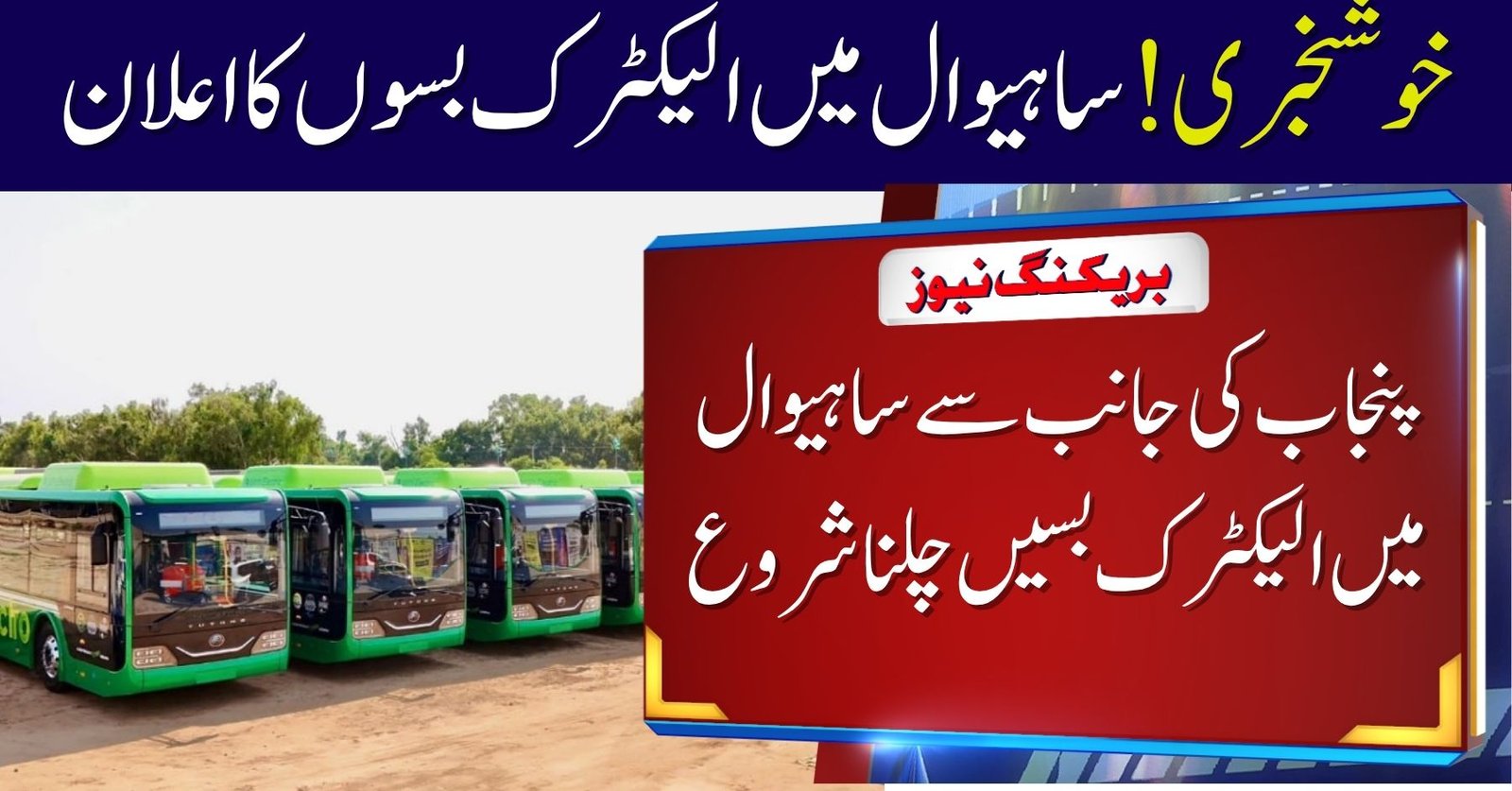
Sahiwal Electric Bus Route
Sahiwal is stepping into a new era of public transport by the presentation of its electric bus service (e-bus / electro-bus). This initiative is meant to provide cleaner, safer, comfortable, and affordable commuting choices for the city’s inhabitants. With government backing, modern topographies, and eco-friendly technology, the scheme aims to decrease traffic congestion, lower emissions, and recover daily flexibility.
Below is a Sahiwal Electric Bus Route quick reference table summarizing the key facts:
| Program / Feature | Start Date / Launch | End Date / Duration | Fare / Benefit | Method / Notes |
|---|---|---|---|---|
| Launch of Sahiwal e-bus service | September 23, 2025 (inauguration) | Ongoing | Regular fare Rs 20 for general public free travel for women, students, seniors, persons with disabilities | Official government launch & continuous service |
| Initial fleet in Sahiwal | Launch phase (2025) | — | 16 buses in first phase, 30 allocated for city | Phase-wise deployment |
| Route coverage and frequency | From launch onward | — | 5 routes initially, 20 min interval | Covers city + nearby towns Harappa, Kamir, etc. |
| Free travel categories | As per inauguration policy | Ongoing | Women, students, seniors, differently-abled ride free | Verified from government statements |
Sahiwal Electric Bus Route and Map
Routes in Initial Phase
In the first phase, 16 electric buses will operate across five main routes, connecting Sahiwal city with surrounding localities and major hubs.
Here are the primary routes:
- Arifwala Bypass → Mai Di Maseet (~22.6 km)
- KFC Bypass → Noor Shah (~27.8 km)
- General Bus Stand → Harappa (via Railway Road) (~24 km)
- Farid Town → Yousafwala (~15.3 km)
- General Bus Stand → Kamir (~27 km)
These routes aim to link key residential, commercial, and transit points within Sahiwal and some nearby towns.
In future phases, the network may expand further across all city zones.
Sahiwal Electric Bus RouteTimings & Frequency
Operating Hours
While official stop-by-stop schedules are not yet fully public, the service is intended to run throughout the day to meet commuters’ needs.
Approximate timings:
- Morning start: early hours (around 6:00 AM onward)
- Service span: spans daytime to evening with breaks as needed
- Interval / Frequency: ~ 20 minutes between buses on initial routes
- Extended / Weekend hours: likely longer service hours to serve market/office demands
Detailed timetable per route should be posted soon at bus stops or via official apps.
Sahiwal Electric Bus Route Fares and Ticketing System
Fare Structure & Free Travel
- General fare: Rs 20 per ride (flat fare) for regular passengers
- Free travel groups: Women, students, senior citizens, persons with disabilities travel free of cost
- Reports of fare up to Rs 35 for longer routes have circulated, but official launch states flat Rs 20 for city rides.
Ticketing & Payment Modes
- The system may use smart cards / digital payment / contactless methods in future deployment to reduce cash use
- At present, payment is expected to be handled in a straightforward way onboard or via simple ticketing until full digital rollout is activated.
- As the project expands, an automated fare collection system (AFC) is likely to be introduced.

Bus Features and Passenger Facilities
Onboard Amenities
The new Sahiwal Electric Bus Route are equipped with modern features to improve comfort, accessibility, and safety:
- Air conditioning (AC) – comfortable ride in all weathers
- Wi-Fi connectivity for passengers
- CCTV cameras for security monitoring
- USB / charging ports for mobile devices
- LED display & audio announcements for next-stop information
- Wheelchair ramps / accessibility features for differently-abled individuals
- Separate women’s compartment / reserved seating for women
- Charging station and depot established for bus maintenance & recharging
These facilities aim to make commuting safe, convenient, and inclusive for all.
Public Reaction & Expectations
Feedback from Sahiwal Residents
Early reactions among the local population are mostly positive:
- Citizens appreciate the low fare (Rs 20) and the free ride policy for special groups.
- Many mention clean, comfortable, timely service as improvements over older transport options.
- People hope the system will reduce traffic congestion, noise, and pollution in the city.
- Students and daily commuters expect more routes and denser frequency for ease of use.
- Some also express a desire to see real-time updates (app, display boards) to avoid waiting too long.
Challenges & Future Expansion
Challenges to Address
- Route coverage: ensuring all neighborhoods are included, not only main roads
- Peak-hour demand: avoiding overcrowding, maintaining frequency
- Electric infrastructure: maintaining battery health, charging station reliability
- Operational costs and subsidies: balancing fare revenue and subsidies
- User information systems: providing reliable route maps, live tracking, and clear schedules
Expansion Plans
- The Sahiwal Division (Sahiwal, Pakpattan, Okara) is allocated 66 electric buses in long term plan. Sahiwal alone to get 26 buses eventually.
- In the first phase, 16 buses will run.
- More routes and buses will gradually be added to cover underserved areas.
- In Punjab overall, the e-bus project is part of a larger vision: launch 1,500 electric buses across multiple cities under phased rollout.
- Plans include expansion to other cities (e.g. Lahore, Gujranwala, Sargodha) with infrastructure support.
Conclusion
The launch of the Sahiwal Electric Bus Service in 2025 is a landmark in modern community conveyance for the city. With a flat fare of Rs 20, free travel for women, students, seniors, and differently-abled persons, comfortable amenities, and eco-friendly processes, this new scheme is set to alter the way inhabitants travel. Though still in its early phase, the infrastructure, route preparation, and public response show strong promise.
As more buses roll out and routes expand, Sahiwal may become a model for other metropolises in Punjab and across Pakistan. In coming months, updates like route maps, mobile apps, and real-time tracking will further enhance the user experience. For now, citizens must keep an eye on official administration gateways, statements, and bus stands for the latest routes, schedules, and facility changes.
Frequently Asked Questions (FAQs)
When did the Sahiwal e-bus service begin?
It was inaugurated on September 23, 2025 by Punjab Chief Minister Maryam Nawaz.
What is the fare, and is there free travel?
General community fare is Rs 20 per ride. Women, students, senior countries, and differently-abled people ride free.
How many buses and routes are in use now?
Initial deployment is 16 buses operating on five routes connecting Sahiwal city with nearby localities.
What features do the buses offer?
Air conditioning, Wi-Fi, CCTV, USB/charging ports, LED displays, accessibility ramps, and separate seating zones including women’s compartments.
How can I find the route map and schedule?
Route maps and detailed schedules should be sent at bus stops, official administration portals, or via movable apps when released. For now, check by your local bus stand or education section statements.
Related Posts